Two homeowners water the same 400 square foot vegetable bed for 45 minutes on the same July afternoon. One uses a rotating overhead sprinkler on a tripod. The other uses a drip line snaking around the base of each plant. The sprinkler user pays for roughly 340 gallons of water, of which the soil absorbs maybe 200. The drip user pays for roughly 90 gallons, of which the soil absorbs about 85. That gap, repeated across a growing season, is the entire argument for drip over overhead spray.
How the Two Systems Actually Deliver Water
Overhead sprinklers throw water into the air in an arc, letting droplets fall onto whatever sits below: plants, soil, walkways, mulch, fence posts. Coverage relies on overlap between heads so that no zone dries out, which means the middle of any zone gets watered twice on every cycle. A running sprinkler is visibly working, which reassures a lot of new gardeners.
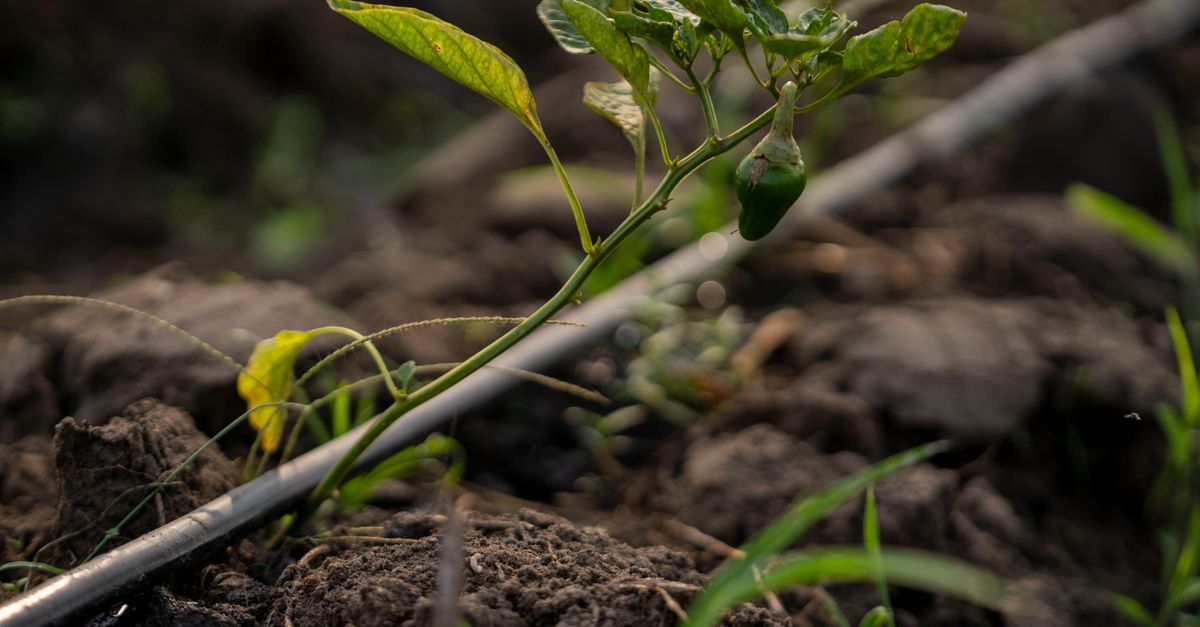
Drip irrigation uses low pressure tubing (typically 15 to 25 PSI) with emitters spaced along its length. Each emitter releases a specific flow rate, usually 0.5, 1, or 2 gallons per hour, straight onto the soil at the base of a plant. The water travels down through the root zone by gravity and capillary action. Nothing lands on leaves, nothing hits the driveway, and nothing evaporates from a droplet catching afternoon sun.
The Efficiency Numbers That Matter
The US EPA WaterSense program pegs the field efficiency of a well designed drip system at roughly 90%, meaning nine out of every ten gallons delivered end up in the root zone. A typical overhead sprinkler system, according to EPA data, comes in between 50% and 70% efficient, and homeowners who water in wind or at midday can lose more than half of the output to evaporation and drift. The EPA covers the practical side of that math on its WaterSense outdoor watering tips page.
That efficiency gap shows up on the water bill. The EPA estimates the average American household uses about 320 gallons per day, and roughly 30% of that goes to outdoor use. In hot dry regions the outdoor share can climb past 60%. If half of what a sprinkler throws is wasted, and half of a household’s water goes outside, then roughly a quarter of the total bill is water the plants never touched.
A Worked Example for a 500 Square Foot Bed
Take a 500 square foot planting area with tomatoes, peppers, and squash on 18 inch spacing, watered three times a week from June through August. That is 13 weeks and 39 irrigation events across the summer.
An overhead impact sprinkler running for 30 minutes at 4 gallons per minute delivers 120 gallons per session. Across 39 sessions that totals 4,680 gallons. If field efficiency is 60%, only 2,808 gallons reach roots. The rest evaporates, drifts onto the lawn, or runs off the mulch.
A drip line with 22 emitters, each running 1 gallon per hour for 45 minutes, delivers 16.5 gallons per session. Across 39 sessions that totals 644 gallons. At 90% application efficiency, roughly 580 gallons reach roots. The drip system uses about 14% of the water the sprinkler uses and gets more of it into the soil. At a US combined water and sewer rate of $0.012 per gallon (a common 2025 suburban number), the season difference works out to about $48 saved on that one bed alone.
Where Sprinklers Still Win
Lawns are the honest answer. A drip line under turfgrass is impractical because grass roots pull water uniformly across a large area, and subsurface drip installations are expensive and hard to repair once buried. Rotor and pop up sprinklers remain the standard for lawns, and the biggest efficiency gains there come from a WaterSense labeled controller and from switching to high efficiency spray nozzles rather than replacing the sprinkler category entirely.
Wide seedbeds also favor sprinklers. When you have just broadcast lettuce or carrot seed across a bed, you want the whole surface damp for a week or two until germination is complete. Drip emitters wet a cone shaped area under each emitter and leave the space between them dry. A fine mist sprinkler covers the whole surface evenly during that short germination window, then a drip line can take over once seedlings are established.
Frost protection is a third case. Overhead sprinklers running through a light freeze can protect blossoms on fruit trees by releasing latent heat as water freezes on the buds. Drip cannot do that.
Installation, Cost, and What Breaks
A basic drip kit for a 200 to 400 square foot bed runs about $40 to $90 at a hardware store: a pressure regulator, a filter, a length of half inch mainline, a spool of quarter inch tubing, a bag of emitters, and end caps. Installation takes an afternoon and requires no digging beyond pushing landscape staples into the soil to hold the tubing flat.
The failure modes are predictable. Emitters clog when unfiltered well water carries sediment, so a 150 mesh filter at the head of the line is not optional. Chewed tubing shows up when squirrels or dogs discover that black tubing smells interesting. UV degradation cracks exposed tubing after four or five seasons, which is why most guides suggest running the main line under mulch.
Sprinklers fail differently. Buried heads snap off when a lawn mower catches them. Pop up seals dry out and start weeping at the base. Rotors drift out of adjustment and start watering the sidewalk. For a closer look at drip versus another low volume option, see our earlier piece on drip irrigation vs soaker hose.
Which One To Choose, Bed by Bed
Match the tool to the planting. Perennial beds, vegetable rows, foundation shrubs, container gardens, and hedges belong on drip. Lawns and dense seedbeds belong on sprinklers, with the caveat that watering time should shift to early morning (between 4 and 8 a.m.) to cut evaporation losses roughly in half. Mixed landscapes usually run both, on separate zones and separate schedules.
The one universal upgrade for either system is a WaterSense labeled irrigation controller. The EPA reports these controllers can reduce outdoor water use by around 15% on average by skipping cycles when soil moisture readings or the local forecast make irrigation unnecessary. Details on the label criteria and current product list live on the WaterSense weather based irrigation controller page.
Common Follow Up Questions
How much does a full drip irrigation conversion cost for an average yard?
For a typical suburban yard with three or four planting beds totaling 800 to 1,200 square feet, expect $150 to $300 in parts if you install it yourself. That covers a backflow preventer, filter, pressure regulator, timer, roughly 200 feet of half inch mainline, a couple hundred emitters, and fittings. Professional installation adds $500 to $1,500 depending on layout complexity and whether existing sprinkler lines can be reused.
Will drip irrigation work if my water pressure is very high or very low?
Drip is designed for roughly 15 to 30 PSI, and a pressure regulator on the main line brings household pressure (usually 40 to 80 PSI) down to that range without any adjustment on your part. Very low pressure setups below 15 PSI can still run drip, but flow rates from emitters drop below their rated output. If pressure sits under 10 PSI, gravity fed drip from a rain barrel is more reliable than trying to run standard emitters.
Does drip irrigation encourage shallow root growth?
Only if the system is run for very short cycles too frequently. The correct approach with drip is fewer, longer waterings that soak the top 8 to 12 inches of soil, which pulls roots downward the same way an inch of natural rainfall would. Running drip for five minutes daily produces shallow roots. Running it for 45 to 60 minutes twice a week produces deep, drought resistant roots that survive dry spells better.
Can I convert my existing sprinkler system to drip without starting over?
Yes, in most cases. Retrofit kits let you cap the sprinkler heads and connect a drip manifold to the same underground supply line, reusing the existing valve and controller. The retrofit typically costs $30 to $60 per zone and takes about an hour per zone. The zone runtime on the controller then needs to be increased substantially, often to 45 or 60 minutes, because drip delivers water much more slowly than any spray head.
How do I know if my drip system is actually delivering the right amount of water?
Dig a small hole with a trowel about an hour after a watering cycle ends. The soil should be visibly moist down to 6 to 10 inches for annual vegetables, and deeper for shrubs and trees. Alternatively, place shallow tuna cans near a few emitters, run the system for a known interval, and measure the accumulated water; multiply by the number of emitters to check total output against the design flow.