The problem with most sprinkler schedules is that they get set once in April and left alone until October. Grass in June needs roughly twice the water it needed in April, and grass in September needs about half of what it needed in July. Running the same 15 minute cycle across all six warm months wastes hundreds of gallons per week and often leaves lawns weaker than a schedule that changes with the weather.
Start With Your Local Reference Rate, Not a Round Number
A seasonal sprinkler schedule works because it tracks evapotranspiration, or ET, which is the combined water lost from soil evaporation and plant transpiration in a given week. Most cool season lawns in the United States need about 1 to 1.5 inches of water per week at peak summer to stay green, and about 0.3 to 0.5 inches per week in early spring or late fall. Warm season grasses like Bermuda or Zoysia generally need roughly 30 percent less water across the board.
Local ET numbers are available through your state extension service or a public irrigation portal such as California’s CIMIS network or the Texas ET Network. Even a rough monthly average is more useful than guessing. Once you know how much water your grass actually loses each week, you can back into how many minutes your zones should run.
The Precipitation Rate Your Zones Actually Deliver
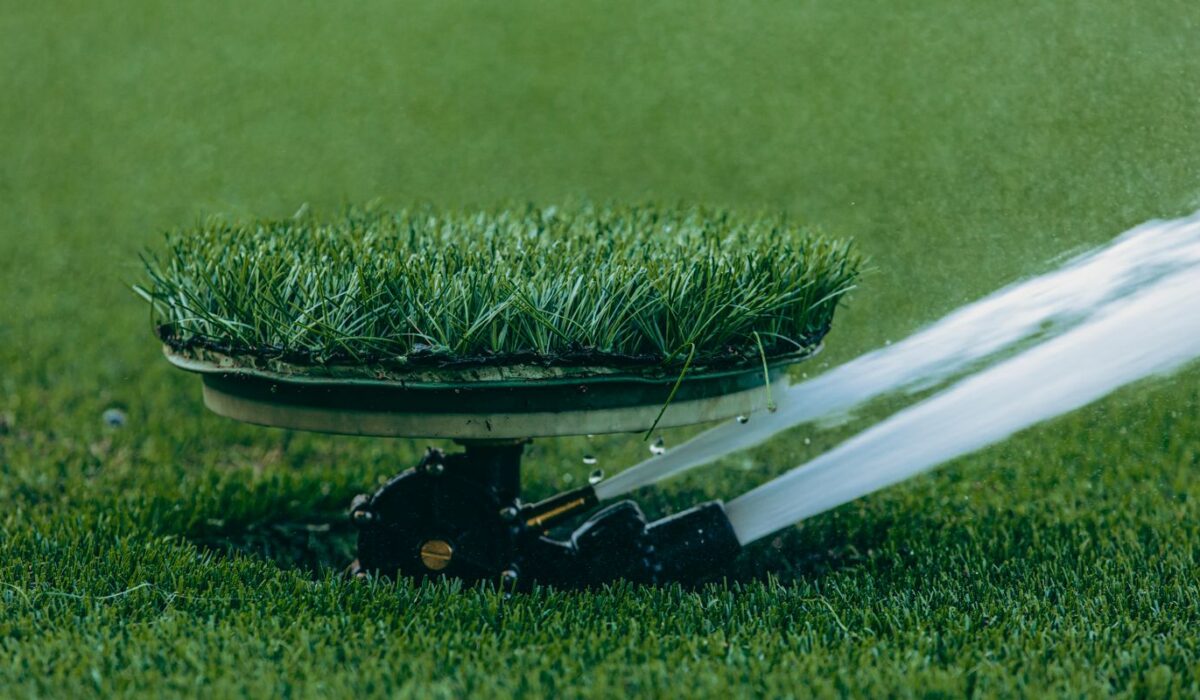
Before touching the controller, you need one more number: how many inches per hour each zone puts down. Fixed spray heads typically deliver 1.5 to 2.0 inches per hour. Rotors deliver 0.4 to 0.6 inches per hour. Rotary nozzles deliver about 0.4 inches per hour. Drip zones are measured in gallons per hour per emitter and use a different calculation.
Do a catch cup test on each zone. Place six straight sided containers across the zone, run the sprinklers for 10 minutes, then average the depths and multiply by six to get the hourly precipitation rate. If a zone puts down 1.8 inches per hour and needs 0.5 inches of water this week, it should run about 17 minutes total. Break that into shorter cycles if you see runoff before the time is up.
A Month by Month Baseline for a Temperate Yard
Assume a Kansas City style climate with cool season turf, fixed spray heads at 1.8 inches per hour, and no significant slope. These are starting points, not rules.
- April: 0.4 inches per week, one cycle of 13 minutes.
- May: 0.7 inches per week, two cycles of 12 minutes.
- June: 1.1 inches per week, two cycles of 18 minutes.
- July: 1.4 inches per week, two cycles of 23 minutes.
- August: 1.3 inches per week, two cycles of 22 minutes.
- September: 0.8 inches per week, two cycles of 13 minutes.
- October: 0.4 inches per week, one cycle of 13 minutes.
Compare that to the “set once and leave” schedule of 15 minutes three times a week that lives on many controllers all summer. Three 15 minute cycles at 1.8 inches per hour deliver about 1.35 inches every week regardless of season. In April that is more than triple what the lawn actually needs; in October it is closer to quadruple. Cutting April and October alone back to a single weekly cycle can save 15,000 to 20,000 gallons per season on a 5,000 square foot lawn.
Worked Example: A 6,000 Square Foot Yard in Late July
Say you have 6,000 square feet of cool season fescue, three fixed spray zones each covering 2,000 square feet, and a precipitation rate of 1.7 inches per hour. Late July ET in your area runs 1.4 inches per week. Rainfall for the week was 0.2 inches, so your net irrigation need is 1.2 inches.
At 1.7 inches per hour, delivering 1.2 inches means about 42 minutes per zone per week. Split into two watering days, that is 21 minutes per zone per cycle. On a heavy clay yard, running 21 continuous minutes causes runoff, so break each cycle into three 7 minute pulses with a 30 to 45 minute soak between them. Most modern controllers support this cycle and soak pattern natively.
Multiplying it out: 6,000 square feet times 1.2 inches times the 0.623 gallon per square foot per inch conversion factor equals about 4,490 gallons for the lawn that week. A poorly tuned schedule delivering 2.4 inches over the same week would consume closer to 8,970 gallons for the same lawn, and much of the extra would run off or evaporate before the roots could use it.
Adjustments the Calendar Cannot See
A monthly baseline gets you 80 percent of the way there. The last 20 percent comes from three ongoing tweaks. First, skip the next cycle after any rainfall event above 0.25 inches. A rain sensor costs 25 to 40 dollars and pays for itself in one summer on most systems.
Second, watch for early morning wilt. Cool season grass showing a bluish gray tint or footprints that stay visible after you walk across it is about a day away from stress. Add one 10 minute cycle before the next scheduled day and reassess. If the lawn perks up without another added cycle, your baseline is close to right.
Third, run everything before sunrise. The EPA WaterSense outdoor guidance notes that watering between 4 and 10 in the morning can reduce evaporation losses by up to 30 percent compared to midday runs, because wind speeds and temperatures are lowest and humidity is highest. That single time shift often saves more water than trimming a minute or two off cycle length.
Where a Smart Controller Actually Helps
A weather based controller (sometimes called an ET controller) pulls local ET and rainfall data daily and adjusts each zone accordingly. The EPA WaterSense specification for irrigation controllers requires that certified models pass a virtual irrigation adequacy test and save at least 20 percent of outdoor water use compared to a standard clock controller during peak season.
The catch is that a smart controller needs correct zone data to be smart. Enter the wrong precipitation rate, plant type, or soil, and it will happily deliver too little or too much water on autopilot. Spending 45 minutes doing catch cup tests and entering real numbers is the difference between a controller that saves 30 percent and one that saves 5 percent. Our post on smart irrigation controllers worth buying walks through which models earn the price and which do not.
Even without a smart controller, spending 10 minutes at the start of each month adjusting run times to match the numbers above will cut most yards’ outdoor water use by 40 to 55 percent over a full irrigation season. That is often 15,000 to 30,000 gallons for an average suburban lawn, and it usually produces a healthier root system than the constant heavy schedule it replaces.
Frequently Asked Questions
Should I water every day if it is really hot?
Daily watering trains roots to stay near the surface, which makes lawns more vulnerable to heat, not less. Two or three deeper cycles per week push roots down 4 to 6 inches, where soil temperatures are cooler and moisture lingers longer. In extended heat above 95 degrees, add one extra weekly cycle rather than shortening the interval between existing cycles. Break long runs into pulses if you see runoff before the cycle finishes.
How do I know my catch cup test is accurate?
Use containers with straight vertical sides that are at least 3 inches tall, not tapered cups. Set them at varying distances from the heads, including the far edge and one directly between two heads. Run the zone for exactly 10 minutes, then measure each cup with a ruler and average the readings. If your highest and lowest cups vary by more than a factor of two, the zone has head spacing or pressure problems that a schedule alone cannot fix.
What if my utility has watering day restrictions?
Most utility restrictions cap you at two or three watering days per week and often specify morning or evening windows. Work within those days by adjusting cycle length rather than day count. If you are limited to two days and July needs 1.4 inches, split that into two longer cycles instead of trying to sneak in a third day. Cycle and soak matters more when runs cannot be spread across four or five days.
How much can a properly tuned schedule save on the water bill?
Outdoor water use is typically 30 to 60 percent of a household’s summer bill in warm climates. Cutting outdoor use in half generally drops summer water bills by 20 to 40 percent, or roughly 15 to 60 dollars per month depending on local rates and lot size. The savings usually pay for a rain sensor within one season and a smart controller within two or three, before counting the value of a healthier lawn that needs less overseeding.