Mowing a residential lawn one inch taller often does more for outdoor water use than installing a smart controller or re-timing the sprinkler schedule. Grass blade length directly controls how fast soil dries, how deep roots grow, and how many gallons the turf actually needs each week. Yet the height dial is the setting most homeowners never touch after buying the mower.
What the One-Third Rule Actually Says
Turfgrass researchers at nearly every US land-grant university teach the same guideline: never remove more than one-third of the grass blade in a single mowing. If a lawn should sit at 3 inches, you cut when it reaches 4.5 inches, not when it looks shaggy at 5 or 6. Cutting more than a third at once shocks the plant, exposes the crown, and forces the roots to draw hard on soil moisture while recovering.
The rule matters for water because a stressed plant sends more energy into replacing lost tissue than into holding roots deep. Roots pulled up shallow by repeated scalping stop reaching the moisture that sits four to six inches below the surface. That soil water is exactly what a well-set lawn should live on between irrigations. Mowing height and mowing frequency are the same setting: if you cut every 10 days and take two inches off, you are outside the rule no matter what number the mower says.
The Right Cut Height by Grass Type
Cool-season grasses, common north of the US transition zone, generally do best at 3 to 4 inches. Tall fescue holds up in summer heat best at 3.5 to 4 inches, Kentucky bluegrass tolerates 2.5 to 3.5 inches, and perennial ryegrass sits at 2 to 3 inches. Many extension services recommend dropping about half an inch in fall and spring when temperatures are cooler.
Warm-season grasses vary more. Common Bermudagrass is bred short and does well at 1 to 2 inches. St. Augustine wants 3 to 4 inches to shade its runners. Zoysia runs 1 to 2 inches. Centipedegrass tolerates 1.5 to 2 inches. Cutting a St. Augustine lawn at 2 inches, a common rental-mower default, invites weeds and roughly doubles the irrigation needed. A yard that looks healthy in July has almost always been kept an inch taller than the neighborhood default.
How Taller Blades Cut Water Loss
A longer grass blade shades the soil it grows in, and shade cuts evaporation. Field measurements from turfgrass research plots have shown that soil under a 3.5 inch canopy runs several degrees cooler than soil under a 2 inch canopy during peak afternoon sun, and cooler soil holds moisture longer between waterings.
The other effect is root depth. Turfgrass root mass tends to mirror top growth. A lawn mowed at 3.5 inches typically pushes roots five to six inches into the soil profile, while a lawn scalped to 1.5 inches often runs shallow at two to three inches. Deeper roots reach reserve moisture that shallow roots miss entirely, which is why a taller lawn goes longer between irrigations without visible stress.
The EPA WaterSense program notes that landscape irrigation accounts for roughly one-third of residential water use nationwide, and as much as half of that water is wasted through evaporation, wind, runoff, or overwatering. Mowing higher directly attacks the first item on that list. The underlying figures are documented on the EPA WaterSense outdoor water use page.
Leaving Clippings Is Not Laziness
Grasscycling, or leaving clippings on the lawn instead of bagging them, is the free companion to a higher cut. Clippings from a properly timed mow are short, break down within a week or two, and return nitrogen and moisture to the soil. Research from several US cooperative extensions estimates that returning clippings can supply about 25 percent of a lawn’s annual nitrogen requirement.
Fresh clippings are roughly 80 percent water by weight, so sitting on the soil for a few days they act as a thin mulch and slow evaporation. Combined with a taller cut, grasscycling measurably drops the irrigation needed to keep a lawn out of dormancy in July and August. The only time to bag is when you fell behind and cutting to target would violate the one-third rule.
Setting Your Mower and Checking the Actual Cut
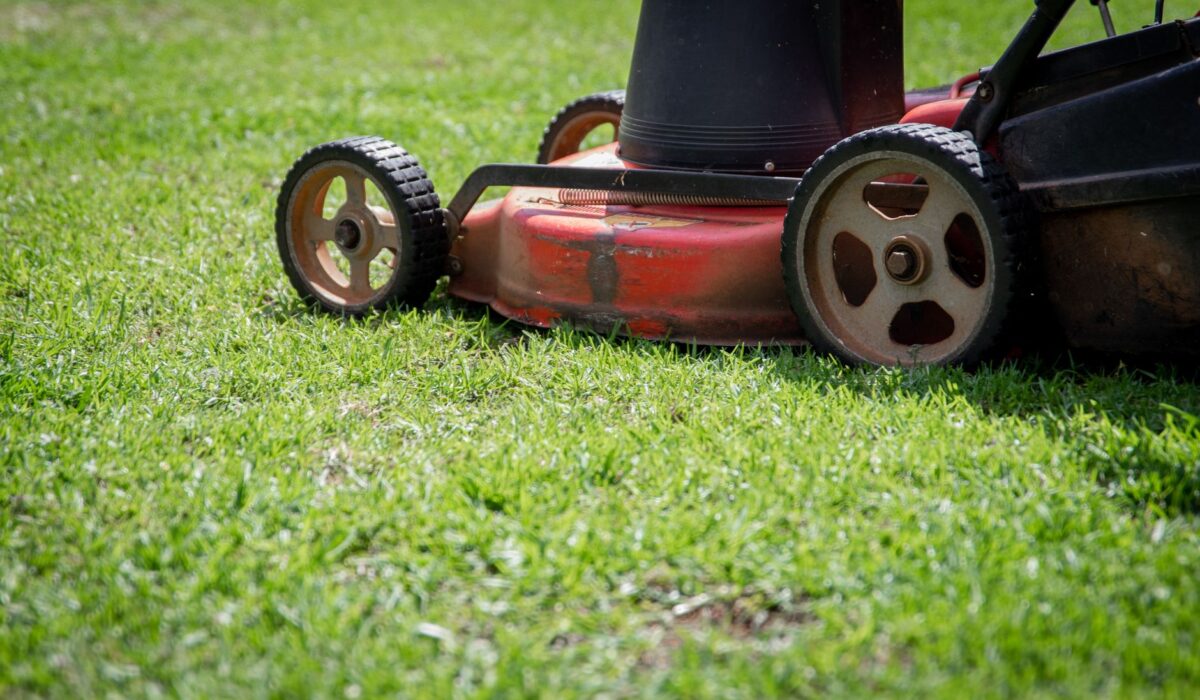
Most rotary walk-behind mowers have five to nine height settings on the wheel levers, and the numbers rarely correspond to inches. To find out what your setting actually cuts at, park the mower on a hard flat surface, measure from the ground to the bottom edge of the blade with a ruler, and write the number down for each position. Mowers vary by half an inch or more between models at the same numbered setting.
Blade sharpness matters as much as height. A dull blade tears grass rather than cutting it, leaving frayed ends that lose water faster and open the plant to disease. A replacement blade costs $15 to $25 at most hardware stores, or you can resharpen the existing one with a metal file in roughly 15 minutes. Once a season is a reasonable minimum for an average yard. If your mower accepts a mulching plug, install it during peak growth.
A Worked Example: Two Yards, One Summer
Consider two identical 5,000 square foot tall fescue lawns in a Midwest suburb. Yard A is mowed weekly at 2 inches. Yard B is mowed every 5 to 7 days at 3.5 inches with clippings left in place. Peak summer irrigation for Yard A runs about 1.5 inches of water per week, roughly 4,675 gallons per week over that footprint. Yard B, with deeper roots and less evaporation, runs on about 1 inch per week, or 3,120 gallons.
Over a 14 week peak irrigation season that is 65,450 gallons for Yard A against 43,680 for Yard B. The 21,770 gallon difference, at a US average combined water and sewer rate near $12 per 1,000 gallons in 2024, is roughly $260 per year. Neither yard bought new equipment or installed a smart controller. The only variable was the mower deck.
The result compounds year over year. Yard B enters fall with a deeper root system, needs less irrigation in October, and recovers faster the following spring. Yard A starts each summer at the same shallow baseline. For a broader summer plan, our piece on surviving a hot summer with half the water you used last year pairs well with a mowing height change.
Frequently Asked Questions
How tall should I let grass grow before mowing if my target height is 3 inches?
Under the one-third rule, mow when the grass reaches about 4.5 inches so that cutting back to 3 removes no more than a third of the blade. In peak growing weather that usually means every 5 to 7 days for cool-season lawns and every 4 to 6 days for warm-season lawns. If the grass already passed 5 inches, trim to 4 first, wait 3 days, then cut again to 3.
Does mowing height matter more than watering schedule for saving water?
They work together, but height comes first. A lawn cut too short will need frequent watering no matter how good the irrigation schedule is, because the roots are shallow and the soil surface heats up quickly. Once the height is right, tuning the schedule to fewer, deeper waterings early in the morning delivers additional savings on top of the height change.
Will taller grass make my yard look unkempt or attract pests?
Neighborhood norms often push mowing shorter than turfgrass science recommends, but a 3 to 4 inch lawn looks tidy when mowed on schedule with a sharp blade and edged along walkways. Pest concerns are minimal at these heights because the canopy is still dense and low, unlike unmaintained meadows that reach 8 inches. Ticks and rodents prefer transitional edges like fences and brush lines, not maintained turf at 3.5 inches.
What if I have shade in part of my yard? Does the height rule change?
Grass in shaded areas needs to be cut even taller than sunny sections, generally by half an inch to one full inch. A shaded fescue patch might do best at 4 inches while the sunny half of the same yard sits at 3.5. Longer blades in shade help the plant capture the smaller amount of light reaching the leaf surface, and shaded soil already loses less water to evaporation.
Do robotic mowers change any of this advice?
Robotic mowers cut a small amount each pass and often run daily, which naturally keeps them inside the one-third rule at whatever height they are set to. The height setting on a robot still matters as much as on a walk-behind. If a robot is set to 1.5 inches on a tall fescue lawn, you will still see shallow roots and higher water demand. Set the robot at the same 3 to 4 inch target you would use for any other mower on that grass type.